
What Makes Original Research Link-Worthy? 7 Experts Explain
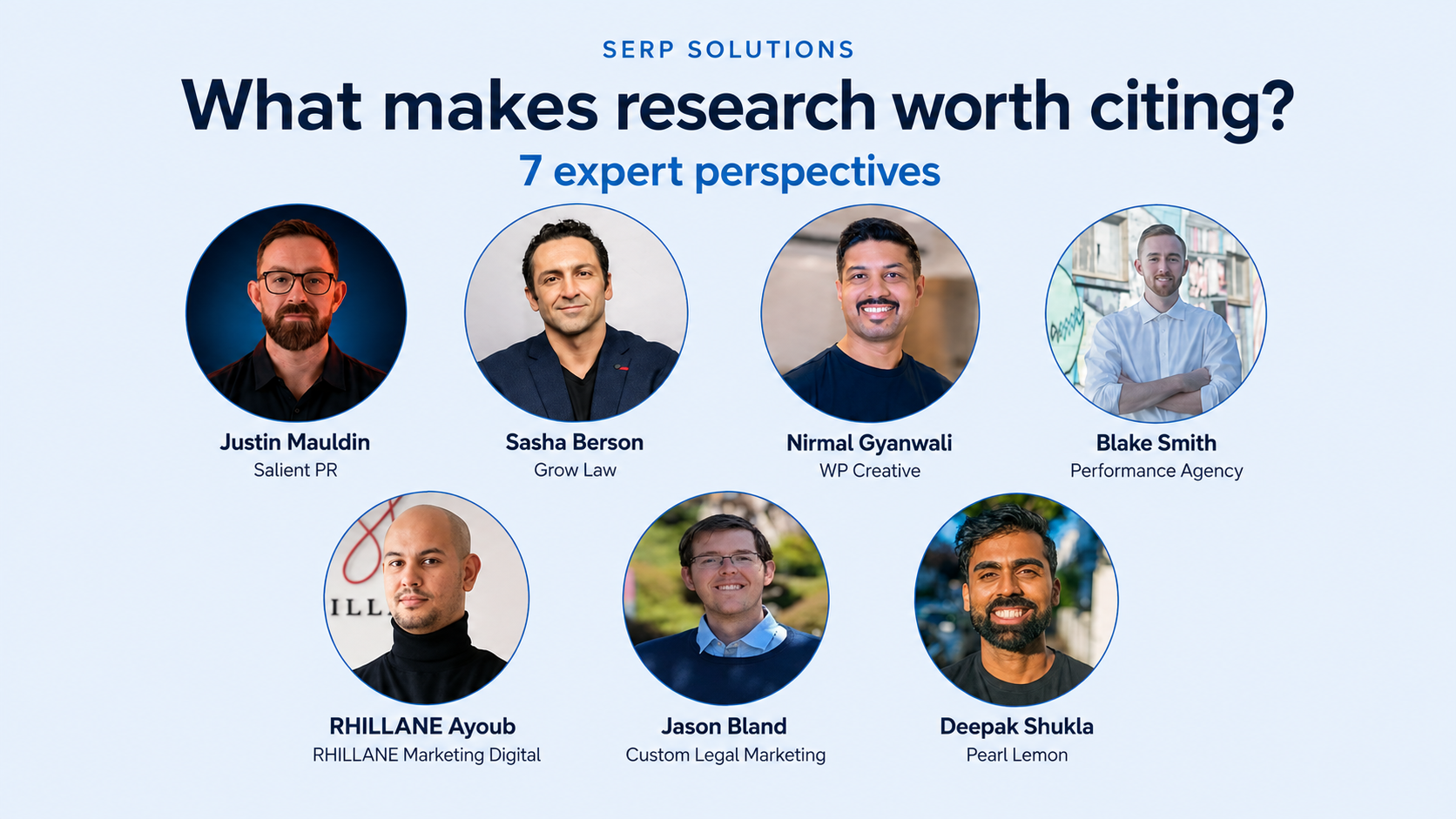
What would make someone use your research in their article? I asked seven SEO and digital PR experts, and here’s what I’d take from their answers for your next study.
If you’re thinking about doing original research to get links, the first question I’d ask is pretty simple. What would someone actually use from it?
You could spend weeks putting a report together. You’ve got the data, a few charts, maybe an interesting headline. But put yourself in the writer’s position for a minute. Why would they include your research in their article? And how would they know they can trust your numbers?
That’s what I wanted to get into, so I asked seven people working in SEO and digital PR what makes research worth linking to. I’ve included their answers below, along with what I’d take from each one if you and I were planning a study.
My short answer: give the writer something useful to say, and show them how you got there. Having data nobody else has is a good start. You still need to give someone a reason to trust it.
What all seven responses have in common
You don’t necessarily need a big survey to do this. Some of the contributors would start with data from their own work. Others would bring public datasets together. What stood out to me was how much of their advice came back to these questions:
- Are you answering something people actually want to know?
- Have you found something they can’t already get elsewhere?
- Can they see exactly who or what you measured?
- Could someone else follow your calculations?
- Have you explained what your numbers don’t tell us?
- Can a writer use the finding without having to work through a sales pitch?
- Is it clear who did the work and who to contact with questions?
1. Justin Mauldin: show people how you got your numbers
 Justin Mauldin, Founder, Salient PR
Justin got me thinking about the information you already collect through your work. Your competitors can buy access to a survey panel too. But they won’t necessarily have the same records of what happened across your campaigns. That’s worth looking at before you pay to collect something new.
“Methodology is boring, and should be available publicly. List the sample size, specific time period, anything that was removed, and the unedited question wording. State who gathered the data and who audited the results.”
He gives the example of a response benchmark using media the organisation has actually placed and categorised over several months. You’re looking at what happened during real work, rather than asking someone what they think might happen.
The bit I’d be careful with is assuming people will trust it just because it’s your own data. If you show me a number, I still want to know what you counted, what you left out, and how you checked it. Justin’s advice gives you a practical list of things to make public.
2. Sasha Berson: give the writer a useful comparison
 Sasha Berson, Co-Founder and Chief Growth Executive, Grow Law
With Sasha’s answer, I’d focus on what the comparison helps you understand. Having a thousand websites in a spreadsheet sounds impressive, but what have you learned about them that a reader would care about?
He suggests a benchmark of 500 to 1,000 websites, looking at things such as organic visibility, speed, content depth, or AI-related technology. If you tried that, you’d also need to explain how you chose those sites, when you measured them, and which ones you excluded.
“For instance, a study that puts businesses in comparison with each other based on specific high-intent keywords can make a great benchmark. This can occur only when the methodology is clear, the amount of data provided is robust enough to arrive at definite conclusions, and any other specialist can understand the data independently.”
For me, the comparison has to tell you something beyond who came first. If I publish a list of the “best” businesses but don’t explain the scoring, why would you use it as a source? I’d rather show you a specific difference, explain how I measured it, and let you decide what it means.
3. Nirmal Gyanwali: give people a reason to come back
 Nirmal Gyanwali, Founder and CEO, WP Creative
I like Nirmal’s point because it makes you think beyond the launch. Someone might use your finding once. But if you keep measuring something useful, they have a reason to check back when they’re writing about it again.
“Research earns links when it hands writers a number they can't find anywhere else and can actually trust. Someone making a claim needs a source, and original data becomes that source on its own merit.”
His examples include conversion-rate and page-speed benchmarks. You can see why someone would return to those. They want to know what’s changed since last year.
Before you call yours an annual report, though, I’d check whether you can collect the same information next year. If you change the sample or the way you measure it, the difference might come from your method. You need to be able to explain that before saying the industry has improved or declined.
4. Blake Smith: you might not need to collect new data
 Blake Smith, Founder, Performance Agency
If you’re reading this thinking you don’t have enough data of your own, Blake’s answer is worth paying attention to. You can start with information that’s already public and ask a question nobody has properly explored with it.
Here’s the Australian construction example he shared:
“For example, for a construction industry client, I might combine ABS building approval data with Jobs and Skills Australia vacancy data for construction trades. That could produce a benchmark showing which regions have the biggest gap between approved building activity and available labour. Both datasets already exist, but the relationship between them could reveal something new and commercially relevant.”
The thing I’d check first is whether those datasets actually line up. Are you comparing the same regions and the same period? Do the categories mean the same thing in both sources? You can get a very convincing chart out of a bad comparison, so I’d want those questions answered before doing anything with the headline.
5. RHILLANE Ayoub: be clear about what you don’t know
 RHILLANE Ayoub, CEO, RHILLANE Marketing Digital
Ayoub brings up the sort of search index used to estimate how many pages get no organic traffic. A journalist probably can’t go away and recreate that whole index to check the result. They need you to explain enough of the work to judge whether they should use it.
He points to three things you should share: the sample size, exactly what you measured and when, and what your dataset can’t see.
“A study that reports only the flattering finding reads like marketing, and editors have learned to smell it. The studies that earn citations tell you where the data is weak, which is exactly what makes a journalist trust the part that is strong.”
I wouldn’t worry that admitting a limitation makes the whole study look weak. Say you only looked at Australian businesses. Tell me that next to the finding, so I don’t accidentally repeat it as a worldwide result. You’re helping me use your work properly.
6. Jason Bland: don’t decide the answer before you start
 Jason Bland, Co-Founder, Custom Legal Marketing
Jason describes working with anonymised search behaviour, split by practice area and location, and comparing it with conversion data from client intake systems. What I took from his answer is that you have to be willing to share a result you weren’t hoping for.
“When you publish findings that sometimes contradict conventional wisdom or complicate the narrative, publishers trust you more. It signals you're reporting what you found, not building a story around a predetermined conclusion.”
It’s easy to get attached to a headline when you’re planning a campaign. But if the numbers don’t support it, you need to let it go. I’d want to see what we actually found first, then work out which part is worth sharing. Otherwise, we’re just looking for numbers that agree with us.
7. Deepak Shukla: compare what people do with what they believe works
 Deepak Shukla, CEO, Pearl Lemon
Deepak’s example asks you to look at two answers together: which techniques people say they use, and which ones they believe work best. If those answers are different, that gives you something to explore beyond a list of popular tactics.
He also wants readers to know who answered, how they were recruited, how many responses came in, and when. And importantly, these are people’s own answers about their work. You haven’t independently measured the results they’re describing.
“That last bit matters. If a methodology looks completely spotless, I'm usually a little suspicious. Good research should show you where the uncertainty is.”
This is a distinction I’d keep clear in your write-up. If someone tells you a tactic works, you’ve learned what they believe about it. You haven’t proved that it caused their results. I’d also want to see the question you asked and where you found the respondents before reading too much into the percentage.
How I’d approach your first research piece
Before you spend time collecting data, I’d try writing one sentence that explains what you want to measure. Leave the result blank. We’re working out the question here, not deciding what the answer should be.
Something like this:
Across [defined sample] measured from [start] to [end], [metric] was [result], compared with [credible baseline or segment].
Can you fill in the sample, dates, and measure? If you can’t yet, that’s where I’d spend the next hour. It’s much easier to sort this out now than after you’ve collected a spreadsheet full of information you can’t use.
Peter’s seven-part link-worthiness test
| Test | Question I would ask | Failure sign |
|---|---|---|
| Editorial demand | Which current story or recurring question needs this evidence? | The topic exists only because we want links. |
| Uniqueness | What can this study say that a competitor cannot publish next week? | The result is a repackaged public statistic. |
| Definition | Can every important term and inclusion rule be stated plainly? | Words such as “best”, “quality”, or “successful” rely on a hidden score. |
| Reproducibility | Could another analyst follow the method and understand the calculation? | The result depends on unexplained cleaning or weighting. |
| Quotability | Can an editor use the finding accurately in one sentence? | The insight needs five paragraphs of qualification. |
| Honesty | Are uncertainty, exclusions, and contradictory findings visible? | Every result conveniently supports the service being sold. |
| Durability | Can the asset be updated, downloaded, and cited after launch week? | Only a temporary press release contains the numbers. |
The methodology page I would publish
If you send me your research, I shouldn’t need to book a call with you to understand where the numbers came from. I’d put these details alongside the findings so a writer can check them in their own time:
- the exact research question and any hypotheses registered before analysis;
- the population, sample size, selection method, geography, and collection dates;
- the original survey wording or source datasets;
- definitions for every calculated metric and segment;
- cleaning, matching, exclusion, deduplication, and weighting rules;
- the number of records removed at each stage and why;
- limitations, possible bias, missing coverage, and what cannot be inferred;
- the named researcher, reviewer, and organisation responsible;
- a downloadable table or machine-readable file where privacy and licensing permit it;
- a correction policy and the date the dataset was last updated.
I’d also keep the findings available as text and tables, even if you make a nice graphic. That gives readers and AI systems something explicit to work with: the number, what it measures, who published it, and its limitations. I wouldn’t promise you AI citations from doing this. It just makes your findings easier to interpret without guessing.
What I’d start with at Serp Solutions
To bring this back to our own work, I’d start by checking what our campaign records could reliably tell you. I’m more interested in answering a practical question about delivery than running another broad poll asking whether links matter.
One idea is an Organic Link Building and Digital PR Delivery Benchmark. We haven’t done this study yet. These are the things I’d explore, using anonymised data we have permission to analyse:
- publisher response and placement timelines by campaign type;
- the proportion of qualified opportunities rejected for relevance, quality, or commercial reasons;
- placement survival and destination changes over a defined observation window;
- differences between guest contributions, expert commentary, data-led outreach, and other legitimate formats;
- which methodology disclosures make research assets easiest for publishers to verify.
Before I could share any numbers with you, I’d need to check whether we have enough consistent records to answer those questions fairly. Client confidentiality and permissions would come first, and I’d want someone else to review the calculations. If the data doesn’t support a useful study, we’d narrow the question or leave it alone.
Where I’d leave you with this
You don’t have to start with a huge report. Pick one question your readers care about and work out whether you can answer it properly with the data available to you.
Then look at the result from the writer’s side. Can they use it? Can they check how you got it? Would it still be useful if they weren’t interested in buying anything from you? Those are the questions I’d want us to answer before we start pitching.
If you’re still deciding how research fits into your link building, I’ve covered the wider approach in my organic link-building guide. You can also look through these natural link-building techniques to compare it with other options.
Contributor note
Responses were provided directly to Serp Solutions through Connectively in September 2026. Quotations reproduce selected passages from the original submissions; surrounding summaries are editorial paraphrases. Roles and organisations are presented as supplied by each contributor. The analysis and recommendations outside the attributed sections are Peter Ngo’s.
Move from research to delivery
Need a managed link-building workflow?
Compare package scope, pricing, campaign inputs, and delivery records across the Serp Solutions service collection.
Explore services